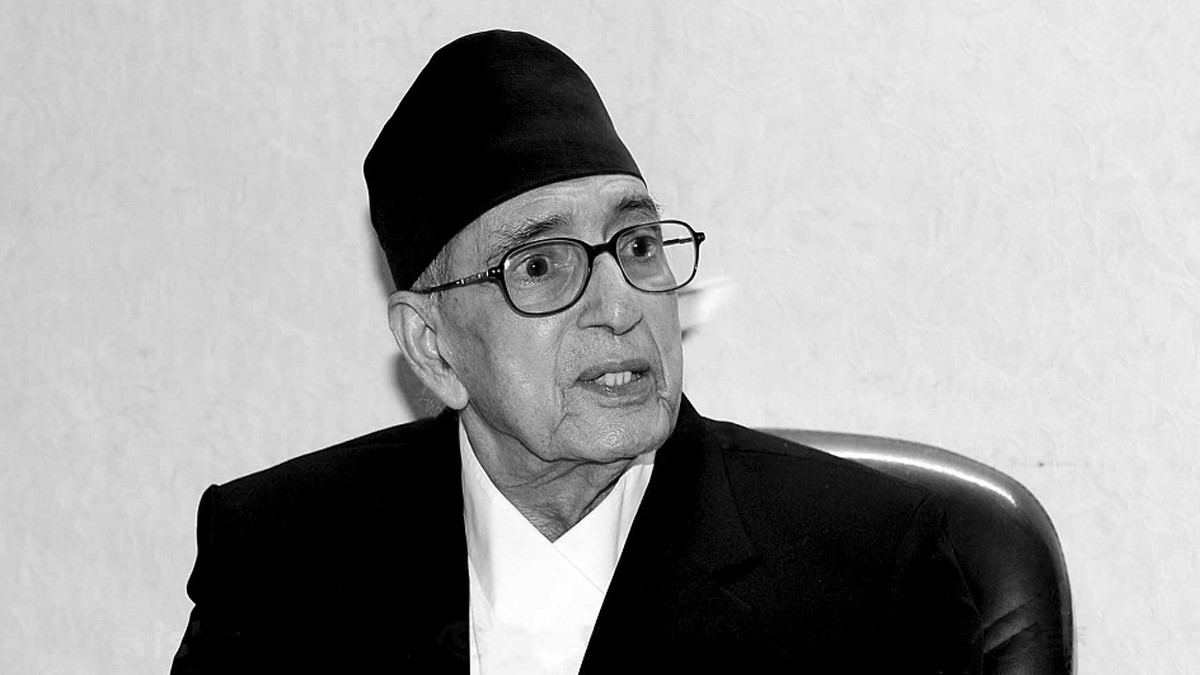
The 16th memorial day of former Prime Minister and former president of Nepali Congress, Girija Prasad Koirala, is being observed today with various programs.
Koirala, who served as Prime Minister four times, passed away on Chaitra 7, 2066 B.S. due to pneumonia. He played a crucial role in ending the Maoist insurgency and establishing peace in Nepal.
After Gyanendra Shah dismissed the elected Prime Minister Sher Bahadur Deuba on Ashoj 18, 2059 B.S., public dissatisfaction toward the monarchy began to rise. Koirala later led major political movements against royal rule.
Following the royal takeover on Magh 19, 2061 B.S., when King Gyanendra assumed direct power, Koirala united political parties and led a mass movement for full democracy. Under his leadership, on Baisakh 11, 2063 B.S., the King agreed to reinstate the dissolved House of Representatives in line with the roadmap of the seven-party alliance—an event often referred to as Nepal’s “Magna Carta.”
After the success of the movement, Koirala became Prime Minister for the fourth time. The reinstated parliament later curtailed the King’s powers, reducing him to a ceremonial role.
Koirala also led the process of integrating Maoist combatants and managing arms. Under his leadership, the long-held dream of his brother Bishweshwar Prasad Koirala to hold a Constituent Assembly election was fulfilled on Chaitra 28, 2064 B.S.
Although the first Constituent Assembly could not promulgate a constitution, it marked a historic turning point, bringing the Maoists into multiparty democratic politics.
During his final tenure, Koirala also served as acting head of state after King Gyanendra was suspended. Under his leadership, on Jestha 15, 2065 B.S., Nepal officially abolished the 240-year-old Shah monarchy and became a Federal Democratic Republic.
Remembering his contribution to peace and democracy, the Nepali Congress and its sister organizations are organizing various programs across the country today.
About the Author