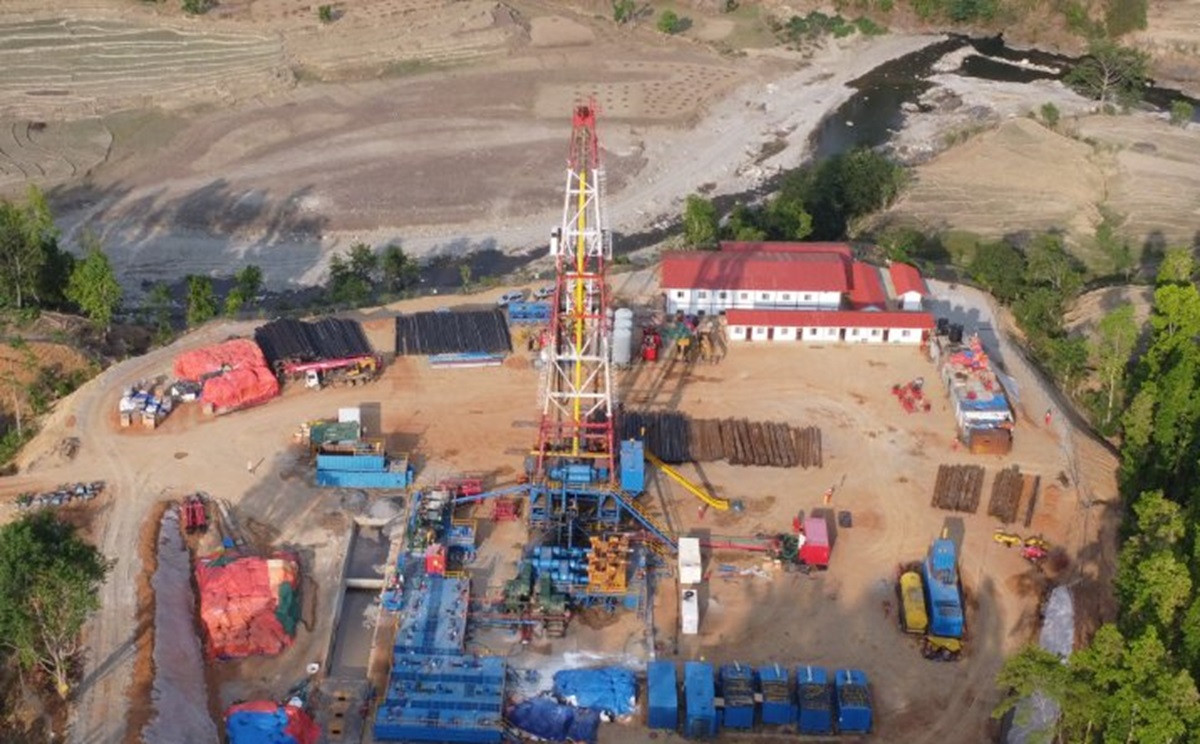
A reserve of 80.70 billion cubic meters of natural gas has been confirmed at Jaljale in Bhairavi Rural Municipality–1 of Dailekh district. According to the final exploration report submitted to the Government of Nepal by China Geological Survey Company, the massive gas reserve has been identified in the area.
Department of Mines and Geology spokesperson Dharmaraj Khadka said the figures were made public following a detailed study by the Chinese technical team. An earlier preliminary report had estimated the reserve at only 1.12 billion cubic meters. However, further testing and final analysis confirmed a significantly larger volume of gas than previously projected.
Although the storage volume has been confirmed, the department stated that the actual commercial production and extraction capacity will only be known after “well testing.” Spokesperson Khadka said, “So far, we have only identified the size of the reserve. Without well testing, it is not possible to determine how much gas can be extracted or which technology would be suitable.”
He added that the next phase will involve using additional equipment at the drilled site to fracture the rock or displace the natural gas. The extracted gas will then undergo laboratory testing to analyze its composition before moving ahead with commercial production.
The Government of Nepal and China Geological Survey had signed an agreement worth Rs 2.40 billion in financial and technical assistance for petroleum exploration. Under the agreement, the Chinese team has completed seismic, geological, magnetotelluric, and geochemical surveys, according to the department.
The department is currently conducting further study on the final report and has requested additional grant assistance from the Chinese government to complete the remaining work.
Experts say the gas discovered in Dailekh is similar to “shale” or “tight gas” extracted in the United States. Such gas is trapped within rock layers, making extraction technically challenging. For commercial use, the rocks must be fractured to release the gas.
Exploration began in October 2019 based on the long-burning natural flames at Shreesthan, Navisthan, Paduka, and Lower Dungeshwar in Dailekh. The gas extraction project has also become a major election agenda for political parties in Dailekh ahead of the upcoming February 21 election.
About the Author