
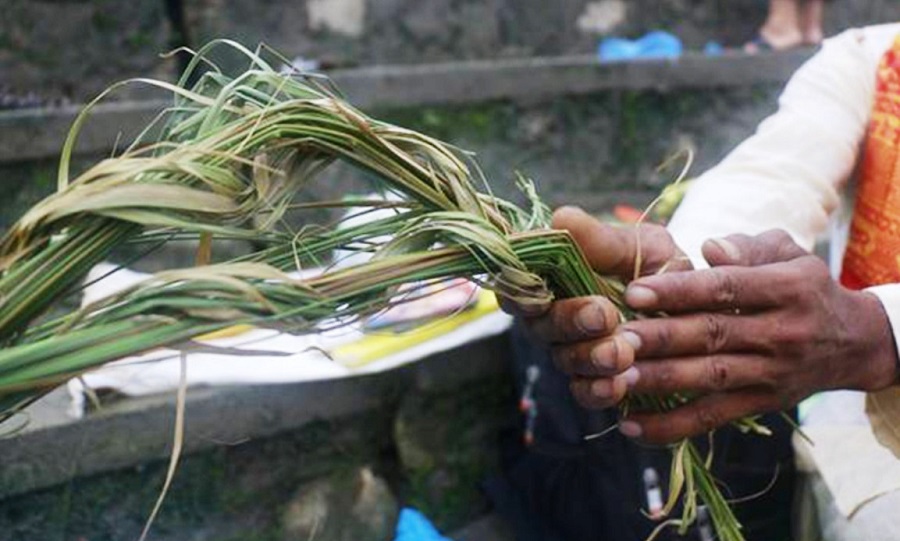
The Kushe Aunsi festival, celebrated annually on the new moon day of the Nepali month of Bhadra (August–September), is being observed today by followers of the Vedic Sanatan Dharma. On this day, devotees bring home sacred Kush grass, which is used throughout the year in various religious rituals for deities and ancestors.
According to scriptures, Kush grass pulled out and consecrated by Brahmins on this day can be used year-round, whereas Kush collected on other days is only valid for use on the same day. Former chairman of the Nepal Panchang Nirnayak Samiti, Prof. Dr. Ram Chandra Gautam, explained that keeping Kush at home is believed to ensure the family’s well-being.
Sanatan believers consider Kush, Tulsi, Peepal, and Shaligram as symbols of Lord Vishnu. Tradition holds that Lord Brahma, the creator, generated Kush grass along with intelligent beings. The Kush placed at homes today will be used in both devakarya (rituals for gods) and pitrikarya (rituals for ancestors) throughout the year.
Honoring Fathers
The day is also dedicated to respecting fathers. Children show reverence by offering their fathers their favorite food and sweets, a tradition popularly known as “Babu Ko Mukh Herne Din” (Father’s Day).
For those whose fathers have passed away, offerings such as tarpan (water oblation), pinda daan (food offerings), and sida daan (ritual donations) are made in sacred places. The most prominent site is Gokarneshwar Mahadev Temple in northeastern Kathmandu, where a grand fair is organized. Because of this, the day is also called Gokarne Aunsi. Similarly, devotees also gather at Betrawati in Rasuwa and Nuwakot for ancestral offerings.
According to scriptures, children who lovingly feed their living fathers and receive blessings attain happiness, while those who perform rituals for deceased fathers at holy sites like Gokarna earn virtue and stability for their lineage.
A Day of Great Merit
The day is regarded as a highly auspicious occasion, as even small donations are believed to yield multiplied rewards. However, scriptures caution that charity should be given to the right recipients (supatra). Donations to the undeserving (kupatra), both by giver and receiver, are said to lead to misfortune.
Thus, Kushe Aunsi is not only a day to honor and remember fathers but also a sacred festival of devotion, ritual purity, and merit.
About the Author