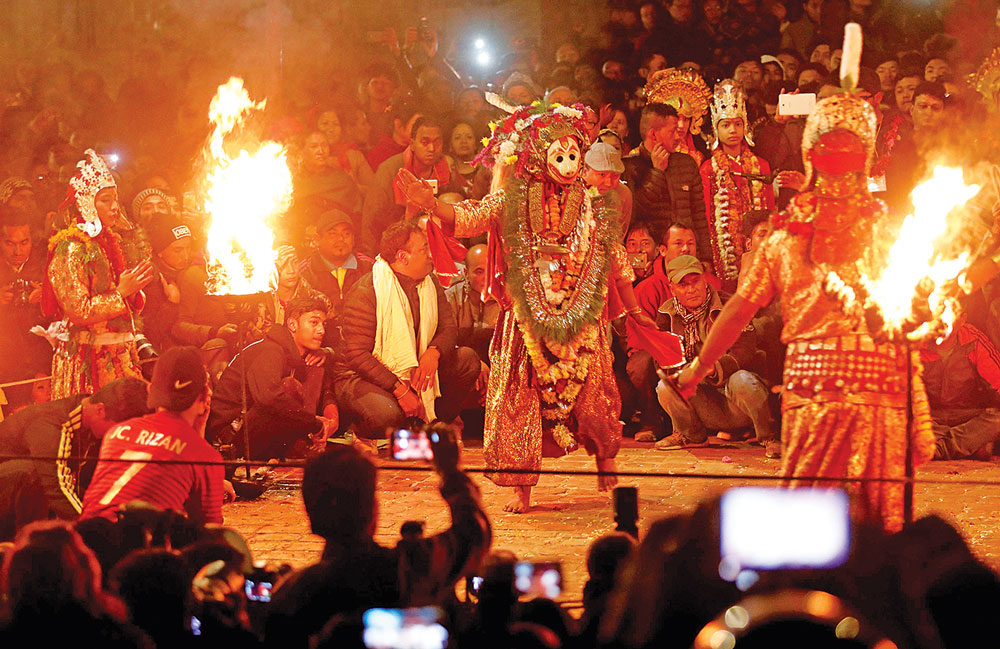
The historic and culturally significant Kartik Naach (Kati Pyakhan), which reveals moral values and social character through dance drama, began on Monday evening at the Dabali near Krishna Mandir in Patan Durbar Square. The ritual dance tradition was initiated in 1697 AD (Nepal Sambat 761) by King Siddhi Narsingh Malla of Lalitpur.
According to Sanjay Sharma Rajopadhyaya, priest of Taleju Temple and member of the Kartik Naach Committee, the dance holds religious and tantric importance. “Kartik Naach was performed to awaken truth and morality in society, and it carries the same cultural value today,” he said. He added that although the dance festival used to continue for a month in the past, it is now limited to 10 days due to various constraints. Despite the reduced duration, a large number of people attend the festival every year.
10 Days, 17 Stories from Hindu Scriptures
The festival opened with the performance titled “Bhakt Surdas Pyakhan”. Each evening at 7 PM, a different dance drama related to Hindu mythology is performed. Highlights include:
| Day | Performance |
|---|---|
| Day 2–4 | Batha Pyakhan, Chwale Khuda Da Khuda, Kaula Khicha, Mahamukha Dance |
| Day 5 | Martial Arts Demonstration |
| Day 6 | Devi Pyakhan |
| Day 7 | Jal Shayan (Slaying of Madhu and Kaitabh) |
| Day 8 | Varaha Avatar (Hiranyaksha Vadh) |
| Day 9 | Narasimha Avatar (Hiranyakashipu Vadh) |
| Day 10 | Vastraharan Leela |
Chairman of Kartik Naach Preservation Committee Kiran Chitrakar said that the drama is based on 17 stories of Lord Vishnu. “It is believed that King Siddhi Narsingh Malla started Kartik Naach for the peace and prosperity of the nation. Each day’s story is portrayed through classical dance and drama,” he said.
Cultural Heritage at Risk
The committee has revealed that Kartik Naach is facing several challenges:
- Lack of financial support
- Migration of skilled artists abroad
- Language difficulties among the younger generation
- Limited time commitment of artists
- Insufficient support from the government
During the Malla era, dialogues in Kartik Naach were performed in Maithili language, but this tradition is gradually disappearing. If sufficient funds are secured, the committee plans to extend the performance back to one full month from next year.
Kartik Naach remains one of the oldest living cultural dance traditions of Nepal and a proud heritage of Patan’s Malla era civilization.
About the Author