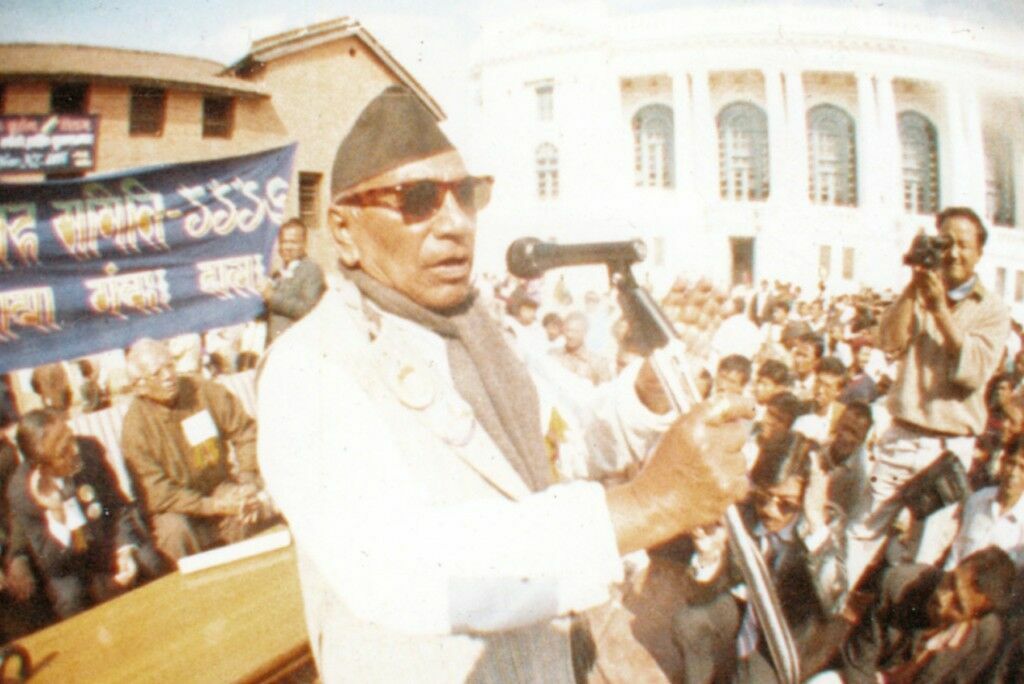
Nepal is observing the 111th birth anniversary of Ganeshman Singh, the supreme commander of the 1990 People’s Movement (Jana Andolan 2046 BS), through various programs across the country today.
Known as a symbol of sacrifice and courage in Nepali politics, Singh earned respect from all political circles. After the success of the 1990 People’s Movement, King Birendra had offered him the position of Prime Minister, but Singh declined and instead proposed his colleague Krishna Prasad Bhattarai for the role—setting a remarkable example of political selflessness.
Born on Kartik 24, 1972 BS, in Chhetrapati, Kathmandu, Singh passed away on Ashoj 2, 2054 BS. Coming from an aristocratic family, he became an active member of Praja Parishad, Nepal’s first political party founded in 1997 BS, which aimed to overthrow the autocratic Rana regime.
For his role in the anti-Rana movement, Singh and several other leaders were imprisoned. Before the 2007 BS revolution, he escaped from Bhadragol Jail and later fled to India, where he established strong political ties with BP Koirala. Singh played a vital role in leading the Nepali National Congress—founded in 2003 BS—through his lifelong dedication and leadership.
As one of the key leaders of the 2007 BS revolution for democracy, Singh led an armed struggle at the Birgunj front. A loyal follower and strong supporter of BP Koirala’s democratic principles, Singh was deeply committed to the restoration and preservation of democracy in Nepal and worked tirelessly to strengthen the Nepali Congress.
After Nepal’s first general election in 2015 BS, Singh served as a senior minister. When democracy was overthrown in 2017 BS, he spent eight years imprisoned—first in Singha Durbar and later in Sundarijal prison. Released in 2025 BS along with BP Koirala, he continued his political activities from exile and later returned to Nepal in 2033 BS, adopting a policy of National Unity and Reconciliation with BP.
He and BP were charged with eight cases demanding the death penalty, but both were acquitted by a special court. Singh also played a leading role in the 2036 BS student movement and the national referendum. After BP’s death, Singh emerged as the supreme leader of the Nepali Congress and led the 2042 BS Satyagraha movement.
Ganeshman Singh’s most significant contribution came in 2046 BS, when he united with the communist forces to launch a nationwide movement against the Panchayat system. As the supreme commander of that movement, Singh became a national hero and a beloved figure across all political divides.
Following the 2017 BS royal coup, Singh was imprisoned in Sundarijal along with BP until 2025 BS. After being released, he went into exile in India but returned on Poush 16, 2033 BS, with the policy of reconciliation—only to be arrested again at Tribhuvan International Airport and jailed for a second time.
On Bhadra 24, 2061 BS, the former Sundarijal detention center was converted into the BP Museum in honor of BP Koirala and other democratic leaders.
On the occasion of Ganeshman Singh’s birth anniversary, the Nepali Congress and its sister and well-wisher organizations are organizing various programs today to commemorate his lifelong contributions to democracy and the nation.
About the Author