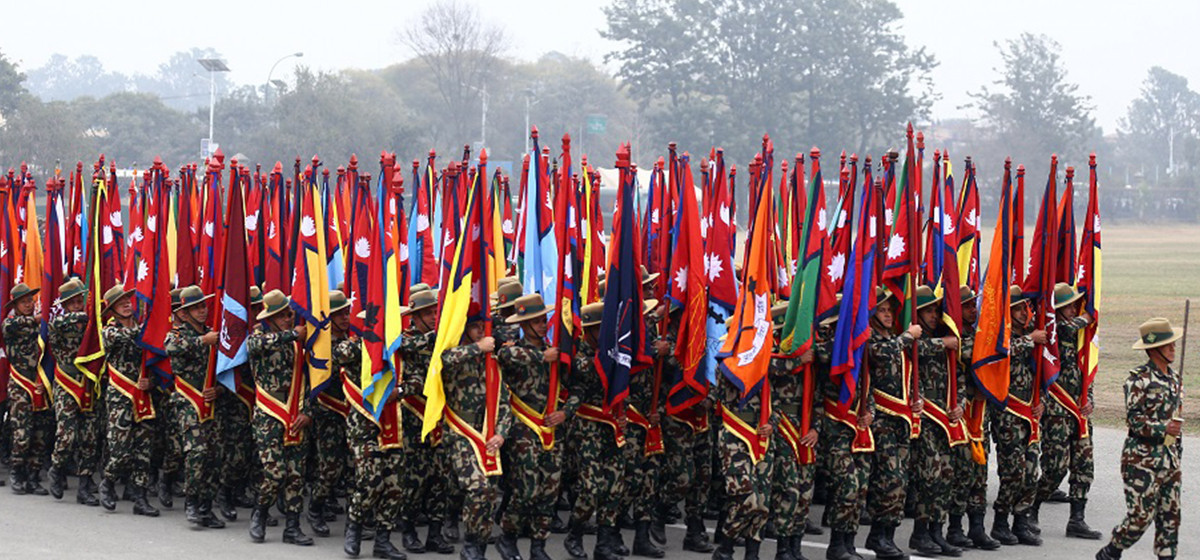
The Nepali Army is celebrating its 263rd स्थापना दिवस (anniversary) on Sunday.
A special Maha Shivaratri and Army Day ceremony is being organized at Tundikhel under the chief patronage of President Ramchandra Paudel, who is also the Supreme Commander of the Nepali Army.
The army observes Maha Shivaratri as Army Day. On this occasion, the Tundikhel stage will host Shivaratri honors along with parades, gun salutes, drills, military displays, and various cultural programs.
According to army spokesperson Rajaram Basnet, Army Day is also being celebrated through various programs under the Jangi Adda headquarters, divisions, brigades, battalions, diplomatic missions, and peace missions.
The current organizational form of the army dates back to 1819 BS. By placing patriotism, dedication, and the welfare of Nepalis at the center of its duties, the army has built strong public trust and confidence. Nepal’s nationhood is founded on the courage, bravery, and sacrifice of its military ancestors, and maintaining national unity is the army’s constitutional responsibility. Discipline, chain of command, political neutrality, and unity remain core values.
Participation in United Nations peacekeeping began in 1958. So far, 162,496 Nepali peacekeepers have contributed across 44 missions. In conflict-affected countries, 74 Nepali soldiers have lost their lives in the line of duty and 77 have been injured. Currently, 4,302 Nepali peacekeepers, including 391 women, are deployed in 10 missions, placing Nepal among leading contributors of female peacekeepers.
Nepal has also become a professional training ground for soldiers from powerful countries. This is reflected by continuous international participation at the Birendra Peace Operations Training Centre in Bhaktapur, the military academy in Kharipati, and the Army Command and Staff College in Shivapuri.
The army has made notable contributions in disaster management and road infrastructure. The national pride project Kathmandu–Terai Madhes Fast Track is being built under army management. Responsibilities such as protecting palaces, forts, museums, historically important structures, hydropower facilities, physical infrastructure, natural heritage, mountain clean-up, and development works have strengthened civil–military relations.
For the upcoming House of Representatives election, an integrated security plan led by the Nepali Army is being implemented to ensure a clean, free, fair, and fear-free environment.
About the Author