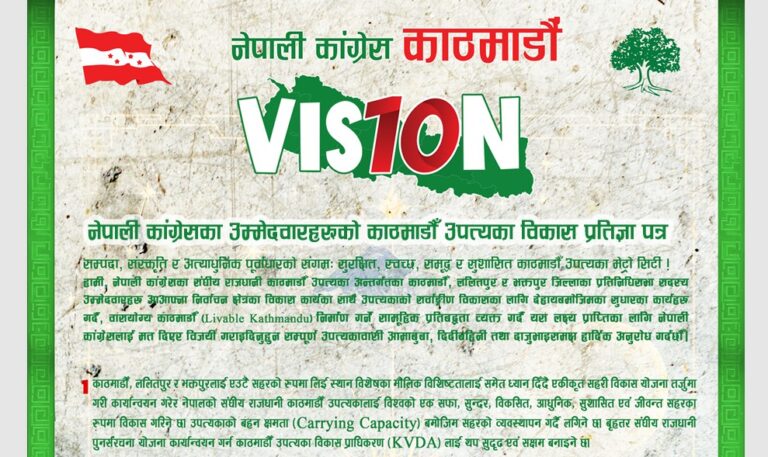
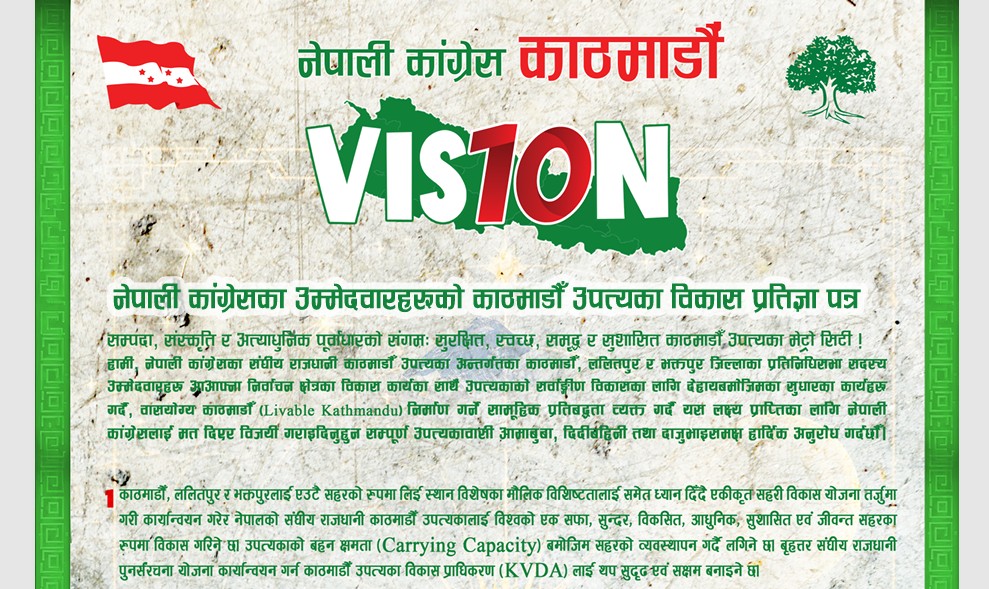
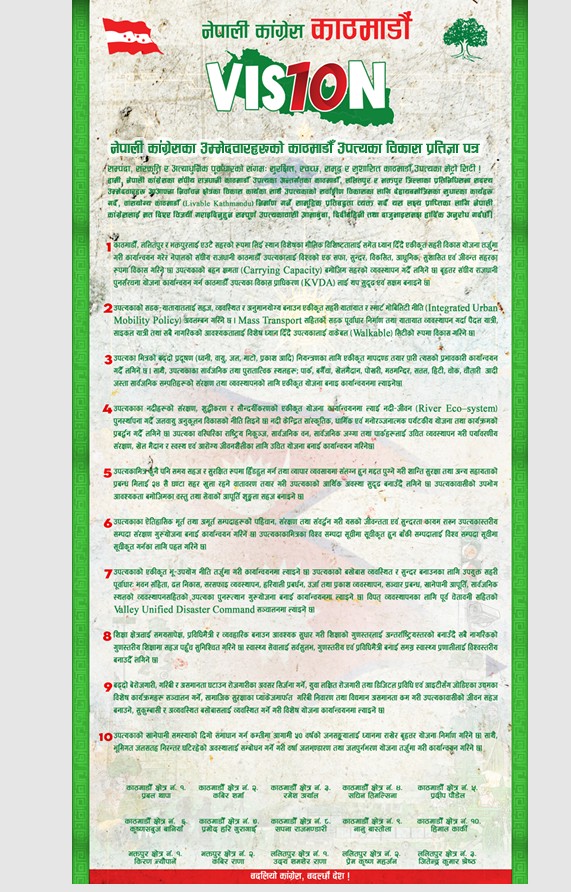
The Nepali Congress candidates for the House of Representatives in the federal capital, Kathmandu Valley, have made public the “Nepali Congress Kathmandu Valley Development Commitment Letter: Vision 10.”
The commitment letter was unveiled at a program held in Kathmandu in the presence of party General Secretary Pradeep Paudel, with virtual participation from candidates of all three districts in the Valley.
The document states that the three districts will be treated as a single city, with an integrated urban development plan formulated and implemented while respecting the unique characteristics of each location. It envisions developing the Valley into one of the world’s cleanest, most beautiful, modern, well-governed, and vibrant cities.
The commitment also includes strengthening the Kathmandu Valley Development Authority to implement a broader federal capital restructuring plan in line with the Valley’s carrying capacity.
Paudel highlighted plans to adopt an integrated urban transport and “smart mobility” policy to make road transportation smooth, organized, and predictable. He said road infrastructure, including mass transport systems, would be developed with special attention to pedestrians and cyclists, aiming to transform the Valley into a “walkable city.”
The pledge outlines the formulation of unified standards to control pollution and integrated plans for the protection and management of public and archaeological sites. It also commits to implementing comprehensive plans for river conservation, purification, and beautification, while protecting nearby national parks, public forests, and parks to promote a healthy lifestyle.
In the education sector, the candidates have pledged to ensure easy access to quality, technology-friendly, and practical education. Similarly, they aim to make health services affordable, high-quality, and technology-driven, gradually building a world-class health system.
The commitment letter also includes plans to formulate and implement an integrated land-use policy, develop urban infrastructure, enforce building codes, manage sewage systems, and execute a revitalization master plan. It proposes operating command centers with early warning systems for disaster management.
To reduce rising unemployment, poverty, and inequality, the candidates have pledged to create job opportunities, especially youth-focused employment programs, and initiatives linked to digital technology and IT enterprises. They also aim to implement social security packages to reduce poverty and inequality, improve living conditions, and manage squatter and unplanned settlements through special programs.
Addressing the Valley’s drinking water crisis, the pledge includes drafting and implementing a long-term plan considering population growth for at least the next 50 years, along with water storage and groundwater recharge initiatives.
Speaking at the event, General Secretary Paudel said sustainable management and development of the Kathmandu Valley remain a top priority for the Nepali Congress. He emphasized that collective commitment would be more effective than isolated efforts and expressed confidence that the document would guide unified action for the Valley’s future development.
About the Author