There is a deep parallel between the human body and the system of the state. Both require a strong immune system to remain alive and functional. In medical science, when the body’s immune system fails to recognize external viruses or begins attacking its own healthy cells, the condition is called an “autoimmune disease.”
Nepal’s politics today is suffering from exactly this ailment. Interim Prime Minister Sushila Karki attempted to clearly articulate this national “disease” when she addressed the National Assembly for the first time on Monday, Magh 19. She told Parliament that her government is eager to conduct clean, fair, and credible elections on the scheduled date and hand over power to a people-elected government.
While explaining the compulsions that led to her appointment as prime minister and the country’s complex situation in her own style, Prime Minister Karki also delivered a multidimensional message that the nation is passing through a difficult phase. As head of government, what she said and did was appropriate. But will the results produced by the elections cure the country’s disease? The answer to this core question remains abstract. Turning that abstract answer into a concrete reality now rests squarely on the shoulders of voters.
Just as antibodies in the human body fight external infections, morality, the rule of law, and ideological integrity act as political antibodies. When these elements erode in politics, viruses like corruption and impunity easily enter society. In Nepal today, these antibodies have become so weak that those who are supposed to protect the Constitution and the law are themselves engaged in undermining them.
When political parties abandon public interest and nurture only the arithmetic of power, the entire system collapses. Nepal’s politics is passing through precisely this stage. In medicine, the most dangerous condition is when the body’s protectors turn into destroyers. In Nepal’s political context, constitutional bodies fall into this category—institutions meant to maintain balance in the state but now intoxicated by injections of partisan interest. The imbalance among the executive, legislature, and judiciary is like vital organs such as the kidneys, heart, and lungs refusing to support one another.
Just as prolonged infection causes permanent damage to the body’s organs, corruption and instability in Nepal’s politics resemble a chronic inflammation. Frequent changes of government, unnatural coalitions, and policy deviations have turned the economy and administrative machinery into something like a multi-organ failure patient.
A person with a weak immune system can be brought down even by a common cold; similarly, a nation with weak political character can be destabilized by minor external pressure or internal conflict. As the immune system gives the body strength to fight viruses, a political immune system protects society from chaos, lies, and cheap populism. Superficial reforms will not heal this deteriorating political health. What is needed is serious “surgery” and “immunotherapy” through elections—completely uprooting criminalization and corruption from politics, bringing forward young leaders with ideological clarity, and restoring discipline to follow the constitutional path as faithfully as DNA follows its code.
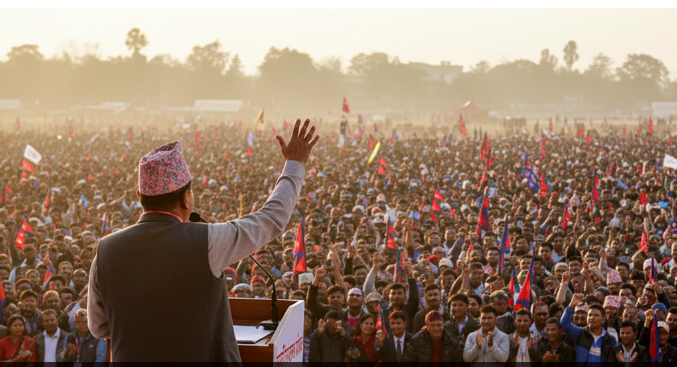
When the political immune system weakens, the virus of populism slowly corrodes the organs of the state. Nepal today appears to be afflicted by this very dangerous populist infection. Populism may sound pro-people, but in reality it is democracy’s autoimmune disease. It offers overly simplistic and cheap solutions to complex problems and continuously blackmails society. Populist leaders capitalize on people’s economic hardship and anger, creating divisions between “us” and “them.” Today, this divide has taken the form of “new” versus “old.”
The moment a leader places himself above law and procedure and claims, “I am your savior,” the destruction of the system begins. Every voter today must be able to identify who is aggressively undermining the system. History shows that the world has moved forward only when leadership abandoned the temptation of popularity and chose the path of public good. Winston Churchill famously said that in democratic politics, leadership is judged not by speeches but by the systems it builds. During the American Civil War, Abraham Lincoln never resorted to cheap slogans. Nelson Mandela, after 27 years in prison, could have pursued revenge politics—something that would have been instantly popular—but instead chose truth and reconciliation, strengthening South Africa’s political immune system.
In Nepal’s context, figures like King Mahendra, B.P. Koirala, and Pushpalal were thinkers who understood the difference between crowds and the people. They never sold their principles for cheap popularity. In this election, voters must also look through that historical window.
Nepal’s politics may not yet be in the ICU, but its immune system stands on the brink of collapse. If moral rejuvenation is not restored within political cells in time, this autoimmune disease could threaten the nation’s very existence. The same truth applies to both health and politics: unless strength comes from within, external medicine alone cannot sustain life.
Antibiotics alone cannot fix a broken political immune system; what is needed is a revival of constitutional morality. The country does not need a superstar leader today, but a visionary who can establish systems. That is the true civic responsibility this election places upon citizens. Populism may earn momentary applause, but history remembers only those who have the courage to choose the right and just path in difficult times.
About the Author