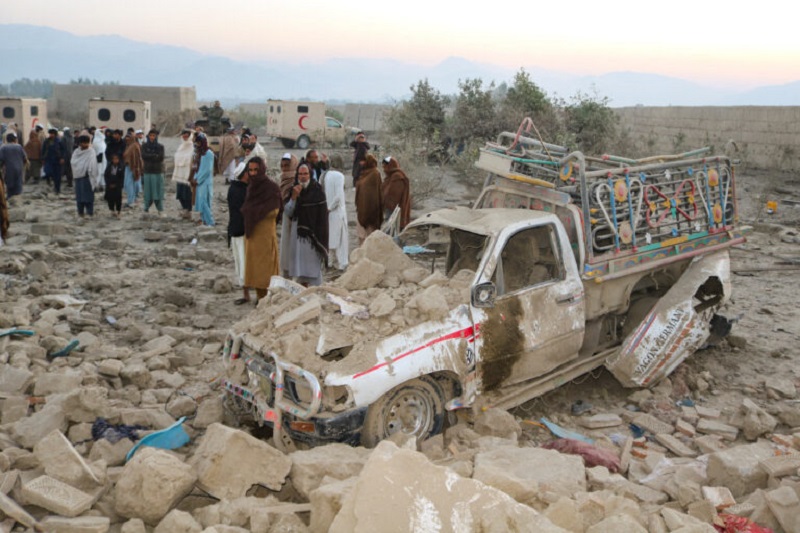
Residents gather at the site, following the Pakistani airstrikes, in Bihsud district, Nangarhar province, Afghanistan, February 22, 2026. REUTERS/Stringer
Pakistan has declared that its conflict with Afghanistan has escalated into an “open war” following recent airstrikes and cross-border clashes. Pakistan’s Defense Minister Khawaja Muhammad Asif said on Friday morning via social media platform X that the country’s “patience has run out” and that an open state of war now exists between the two nations.
He claimed that after the withdrawal of NATO forces, Pakistan had expected peace to be established in Afghanistan, but alleged that the Taliban government chose a different path. He accused the Taliban of turning Afghanistan into “a colony of India,” gathering extremists from around the world, and exporting terrorism instead of focusing on the welfare of the Afghan people and regional stability. “Our patience has now ended. There is open war between us,” he stated. There has been no immediate response from Afghan government officials regarding his remarks.
The statement came hours after Pakistan carried out airstrikes in Kabul, Kandahar, and Paktia provinces. According to Pakistani officials and Afghan government spokesperson Zabihullah Mujahid, the strikes were reportedly conducted in response to cross-border attacks originating from Afghanistan. Although a ceasefire had been brokered months earlier through mediation by Qatar and Turkey, recent developments indicate that tensions have flared up again.
Both sides have claimed to have inflicted heavy losses on each other, though these claims have not been independently verified. Afghanistan’s Ministry of Defense stated that 55 Pakistani soldiers were killed during overnight operations, some bodies were taken into Afghanistan, and several others were captured alive. It also reported that eight Afghan soldiers were killed and 11 injured. The ministry claimed that 19 Pakistani posts and two bases were destroyed, and that the clashes, which began on Thursday, lasted about four hours before subsiding around midnight.
Meanwhile, Pakistan’s Information Minister Attaullah Tarar said two Pakistani soldiers were killed and three injured. A spokesperson for Prime Minister Shehbaz Sharif rejected claims that any Pakistani soldiers had been captured, stating that at least 133 Afghan fighters were killed and more than 200 injured. According to him, 27 Afghan posts were destroyed and nine fighters were detained. While the exact locations of the casualties were not specified, he indicated that major damage was inflicted on military targets in Kabul, Paktia, and Kandahar.
Two senior security officials in Islamabad also claimed that Afghan forces raised white flags at some border posts, a gesture generally interpreted as a signal to cease fire. Speaking on condition of anonymity, they said Pakistani forces had delivered a strong response to what they described as an “unprovoked attack” by the Afghan Taliban and destroyed key Taliban positions in border areas.
Defense Minister Asif further accused the Taliban government of neglecting fundamental human rights, including those of women, which he said are guaranteed under Islam. However, no detailed evidence was presented. He added that Pakistan had attempted to maintain stability through direct and allied diplomatic efforts, but after increased aggression targeting Pakistan, its armed forces delivered a “decisive response.”
As tensions escalate, humanitarian impacts have begun to surface. Pakistani officials reported that dozens of Afghan refugees waiting to return through the northwestern Torkham border crossing were relocated to safer areas after clashes intensified. Since October 2023, Pakistan has launched a broad crackdown on undocumented migrants, urging many to leave the country to avoid arrest and forced deportation, while others have already been expelled. Iran has also tightened measures against migrants during the same period.
About the Author