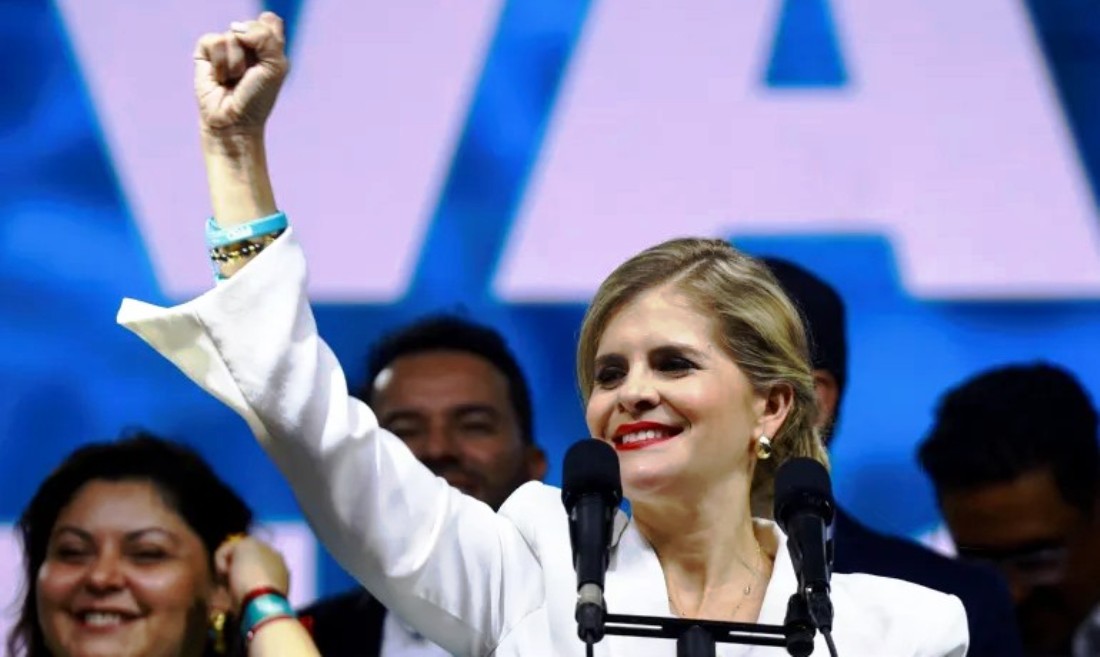
Right-wing political scientist Laura Fernández has been elected President of Costa Rica. Her victory, influenced by the style and hardline security policies of El Salvador’s President Nayib Bukele—who calls himself “the world’s coolest dictator”—is being viewed as a continuation of the aggressive leadership trend seen recently in Latin American politics.
At 49, Fernández is considered the political successor of outgoing conservative President Rodrigo Chaves. During Chaves’ tenure, she served as Minister of Planning and Chief of Staff. She is the second woman to become president of Costa Rica after Laura Chinchilla, who governed from 2010 to 2014.
Fernández has identified rising violence as the country’s main challenge, in what was long considered one of Central America’s most stable and peaceful nations. With coastlines on both the Caribbean and the Pacific, Costa Rica was once merely a transit point for Colombian and Mexican drug cartels but has now turned into a logistics hub. As drug trafficking has spread into local communities, gang clashes have increased, and the homicide rate has risen by nearly 50 percent over the past six years.
Against this backdrop, Fernández has pledged to complete the construction of mega-prisons for dangerous criminals and impose emergency measures in crime hotspots, drawing inspiration from Bukele’s tough security model. During her campaign, she said strict measures would be taken to remove criminals from the streets and place them behind bars.
However, human rights groups have issued strong warnings against copying such a model. They argue that while El Salvador’s approach produced short-term crime control results, the detention of thousands without charges has seriously undermined civil liberties. Some critics have portrayed Fernández as merely continuing Chaves’ populist agenda and fear her presidency could pave the way for his return to power.
Within the ruling camp, there has been discussion about amending the constitution to allow Chaves to contest elections again sooner. Fernández has not completely ruled out including Chaves in her cabinet. Critics describe her political style as confrontational and populist, noting that her rhetoric—portraying the judiciary as soft on crime and the political elite as detached from the public—has sparked intense debate. Former President Chinchilla has labeled her style a “poor imitation of presidential leadership.”
Born in the Pacific coastal city of Puntarenas to a farmer father and a teacher mother, Fernández often recalls her rural upbringing. Married twice, she is the mother of a three-year-old daughter and describes herself as economically liberal but socially conservative. Her hardline positions on abortion, euthanasia, and family values have drawn both support and criticism.
On the eve of the election, local media reported alleged agreements with ultra-conservative evangelical groups involving the exchange of support for government positions, keeping the direction of her potential administration at the center of controversy.
About the Author