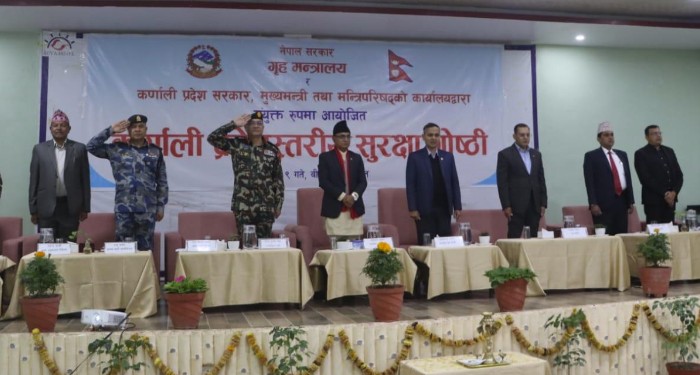
The security apparatus has intensified its preparations to ensure that the House of Representatives election scheduled for February 21 is conducted in a free, fair, and fear-free environment. In this context, a province-level security seminar was held on Wednesday in Birendranagar, Surkhet, the capital of Karnali Province, with the participation of chief district officers and heads of security agencies from all ten districts of the province.
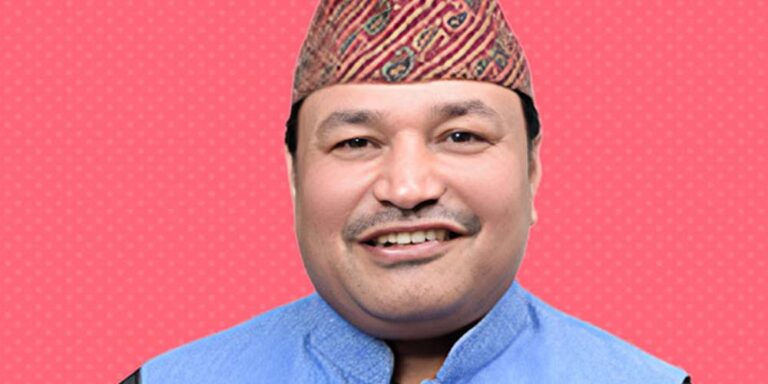
The seminar, held under the chief guestship of Home Minister Om Prakash Aryal, focused on in-depth discussions on the “Integrated Election Security Plan–2082.” As the government prepares to recruit around 136,000 temporary police personnel nationwide for the election, district-wise reporting was presented on challenges related to polling center security and ballot transportation, particularly in the remote areas of Karnali. Home Minister Aryal stated that the February 21 election is essential for resolving the country’s political deadlock and directed security chiefs to overcome challenges and ensure the election is held on time.
During the seminar, security challenges arising from Karnali’s difficult geography, increasing drug abuse, and the recent impact of the “Gen Z” movement were analyzed. Chief Minister Yamlal Kandel drew attention to shortages in security manpower and coordination difficulties with the federal government, stressing that citizens must directly feel the presence of peace and security.
Home Secretary Rameshwar Dangal, Inspector General of Police Dan Bahadur Karki, Nepali Army Lieutenant General Ganesh Kumar Shrestha, and Armed Police Force Additional Inspector General Raju Aryal, among other senior officials, presented security action plans. The meeting also decided to strengthen coordination among all four security agencies—the Nepali Army, Nepal Police, Armed Police Force, and National Investigation Department—to prevent possible clashes, booth capturing, and other election-related disturbances.
The seminar is expected to finalize plans related to security personnel mobilization, budget management, and the classification of polling centers into normal, sensitive, and highly sensitive categories for the upcoming election.
About the Author