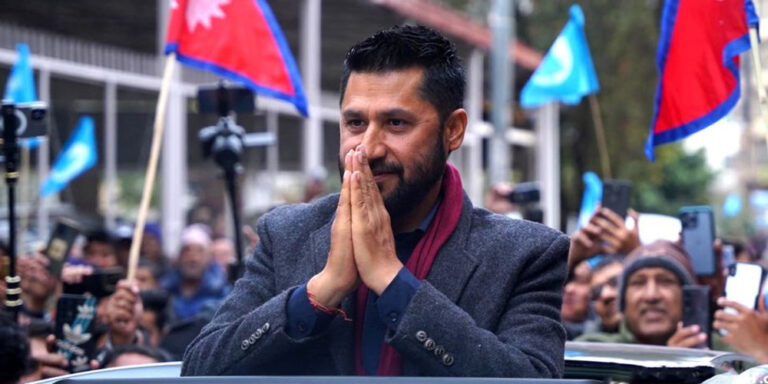

CPN-UML Deputy General Secretary Pradeep Gyawali has said that holding a policy debate at the upcoming National General Convention is not relevant. His remarks come at a time when Senior Vice Chairman Ishwar Pokharel is preparing to present a different proposal at the party’s 11th National Convention starting Saturday in Bhaktapur.
Posting a long status on Facebook on Wednesday, Gyawali wrote, “When policy and leadership decisions are made from the same platform, policy debates get overshadowed and leadership bias influences discussions. Based on past experiences, we have arranged the Statute Convention and the National Convention separately. Therefore, discussing leadership during the Statute Convention and discussing policy during the leadership-selection National Convention is not appropriate.”
During the Statute Convention held on September 7 and 8 in Godavari, Lalitpur, the UML decided to remove the two-term limit and the 70-year age cap. The membership renewal of former Vice President and former President Bidya Devi Bhandari was also kept pending. Pokharel, Bhandari, Astalaxmi Shakya, Surendra Pandey, Yuvaraj Gyawali, and others had expressed dissatisfaction with the decision.
At a time when Pokharel is preparing to challenge KP Sharma Oli for the chairmanship for the third term, Gyawali has spoken in defense of the current leadership. He clarified that if any changes in national politics arise between conventions and if policy adjustments are needed, the authority for such decisions is given to the Central Committee.
Gyawali wrote, “If a significant political change occurs between conventions and existing policies need revisions, the Central Committee has the authority to make those changes. It is neither possible nor practical to organize a convention for every issue or to use the same platform for all discussions.”
He further suggested that the upcoming convention should remain focused on leadership selection and emphasized making every effort to reach a consensus. If consensus is not possible, he stressed the importance of a healthy, respectful, and democratic process to strengthen party unity.
Gyawali added, “Certainly, an objective review of our achievements and shortcomings is necessary. But such a review cannot remain objective during times of emotional distance and factional divisions—it turns into accusations and a blame game. When leadership is facing serious challenges, and even different opinions are emerging regarding the volunteer organization established under party statute, a comprehensive and balanced analysis is not possible at this moment.”
About the Author