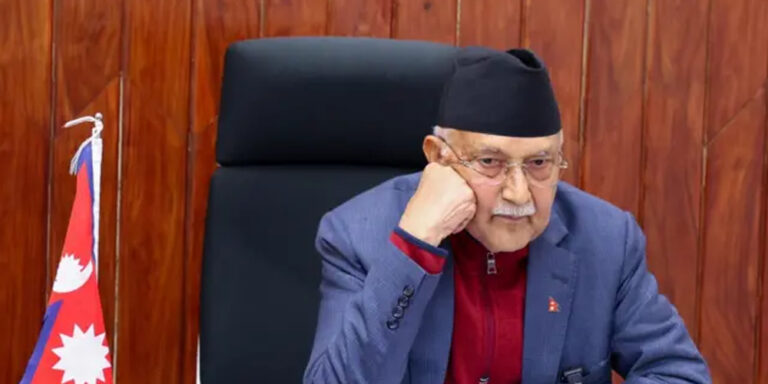
Kathmandu — A commission report has raised serious concerns over the leadership of former Prime Minister KP Sharma Oli during the violent incidents that occurred on Bhadra 23 and 24 amid the Gen-Z protests.
The report states that as the executive head, the Prime Minister bears ultimate political and administrative responsibility over state mechanisms, security agencies, and subordinate institutions. However, it concludes that Oli failed to respond effectively during the crisis.
During Oli’s tenure, the National Investigation Department was brought under the Office of the Prime Minister and Council of Ministers from the Home Ministry. The department reportedly made a weak and inaccurate projection, estimating that only 3,000 to 5,000 people would take to the streets on Bhadra 23. This miscalculation led to inadequate security preparedness.
According to the commission, shortcomings in intelligence analysis, cyber monitoring, and risk assessment exposed inefficiencies within the Prime Minister’s Office itself.
Although a meeting of the National Security Council was held on the evening of Bhadra 23, the report notes that no concrete, written, or actionable decisions were made to address potential risks the following day. It also highlights that decisions such as lifting restrictions on social media were made without sufficient study or security analysis.
The report further states that despite being informed about a four-hour-long clash in front of the Federal Parliament building, the Prime Minister did not take decisive steps to coordinate security agencies, mobilize the army, or control the situation.
In its conclusion, the commission emphasizes that the lack of timely leadership allowed the protests to escalate, resulting in violence reaching sensitive locations such as Shital Niwas and Singha Durbar.
About the Author