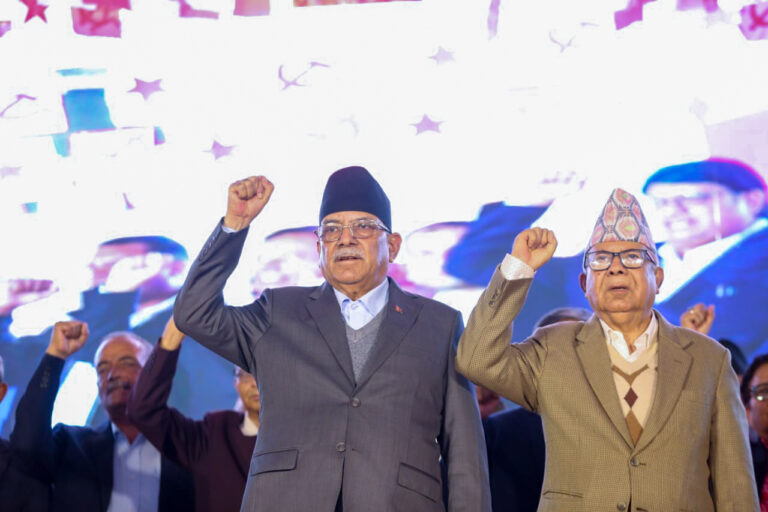
Clear signs of polarization are emerging in Nepal’s politics between traditional parties and new political forces following the Gen Z uprising. On Monday morning, former Prime Minister and Nepali Congress President Sher Bahadur Deuba was visited at his Maharajgunj residence by another former Prime Minister and CPN-UML Chair KP Sharma Oli.
It is understood that Deuba and Oli, both of whom lost state power due to the Gen Z uprising, discussed the restoration of Parliament, coordination in the upcoming National Assembly elections scheduled for Magh 11, and possible future power equations. In line with their understanding, the Nepali Congress and UML jointly filed a supplementary petition at the Supreme Court on Tuesday, submitting signatures of 143 lawmakers from the dissolved House of Representatives, demanding parliamentary restoration.
Although the Nepali Congress Central Working Committee had decided on Mangsir 6 to go for elections, Deuba has recently agreed with Oli’s proposal on restoring Parliament. Oli is said to have met Deuba several times to convince him. This was the first time the two leaders met after the Gen Z movement on Mangsir 19, also at Deuba’s residence. Following those discussions, eight lawmakers including Congress Chief Whip Shyam Prasad Ghimire filed a writ petition on Mangsir 23 seeking parliamentary restoration. UML had already filed a similar petition on Mangsir 9.
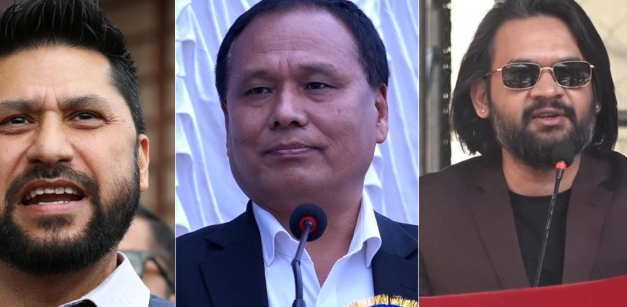
Challenging this emerging alignment, Rastriya Swatantra Party (RSP) Chair Rabi Lamichhane and Kathmandu Metropolitan City Mayor Balen Shah held an intensive five-hour meeting on Monday evening. The discussion, hosted at the Kamalpokhari office of RSP central member Asim Shah, began at 8 pm and concluded around 1 am. After the meeting, Lamichhane and Balen were seen leaving together in the same vehicle, smiling.
Speaking to journalists, Asim Shah described the meeting as positive, saying it reflected both political necessity and public sentiment. He stated that the discussion emphasized the need for unity to rebuild the country and expressed confidence that such dialogue would continue. The meeting included Lamichhane, Asim Shah, Vice Chair DP Aryal and other RSP leaders, while Balen was accompanied by his aides including Kumar Ban.
Despite the significance of the meeting, both sides have kept the details confidential, and neither Lamichhane nor Balen has issued an official statement. RSP leader Ganesh Parajuli said the meeting was aimed at breaking the “syndicate” of old political parties and asserted that Lamichhane and Balen had come together for that purpose. He added that RSP plans to move forward in the upcoming elections by collaborating with change-oriented figures such as Balen Shah, Kulman Ghising and Harka Sampang.
RSP political dialogue committee co-coordinator Shishir Khanal also confirmed the meeting but said he was not aware of its internal details. He informed that Lamichhane plans further discussions with Energy Minister and Ujyalo Party patron Kulman Ghising after returning from Chitwan. Khanal clarified that while party unification with some groups may not be possible, electoral alliances remain an option.
Lamichhane himself said the party is continuing dialogue to unite new and alternative political forces, stressing that discussions are still at an early stage and that speculation should be avoided. He reiterated that RSP sees it as its responsibility to bring all alternative forces together in line with public aspirations for change.
Political analysts remain divided on whether the situation truly signals polarization. Analyst Bhim Bhurtel argued that while Congress and UML coming together may appear as a compulsion, it does not necessarily amount to polarization, suggesting that mass public demonstrations could still reshape political outcomes. Analyst Keshav Dahal, meanwhile, said it is unrealistic to expect all old parties to unite on one side and new parties on the other, noting that both camps are internally diverse in ideology, agenda, and motivation.
Overall, while the Gen Z uprising has shaken Nepal’s political landscape and intensified dialogue among both old and new actors, whether it will result in clear-cut political polarization remains an open question.
About the Author