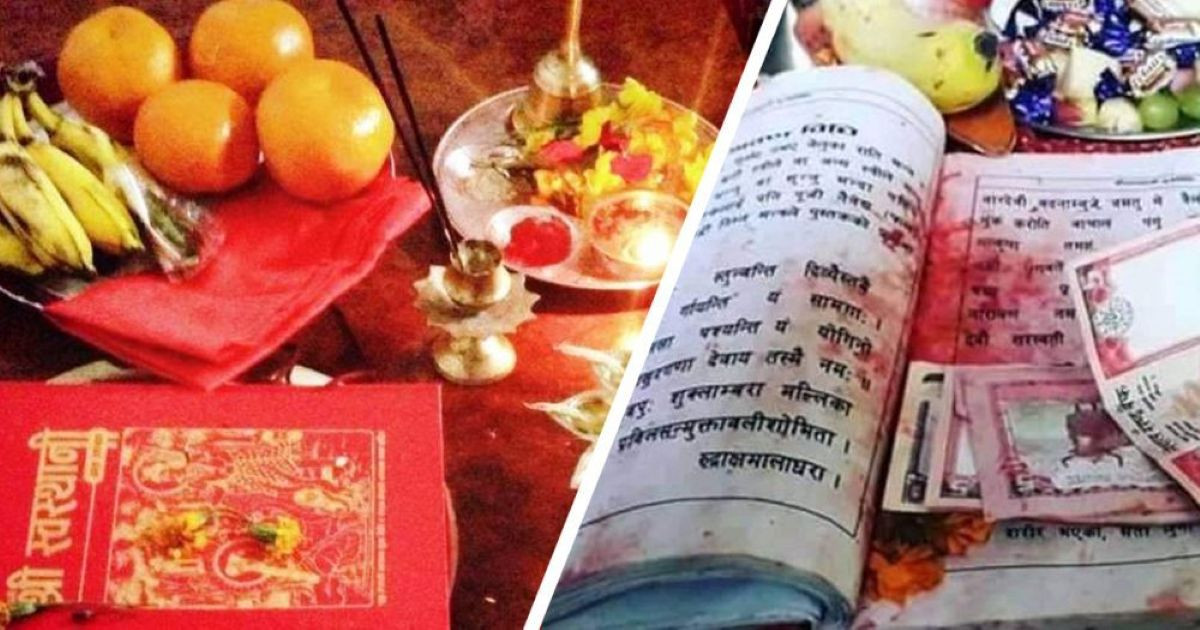
From Paush Shukla Purnima to Magh Shukla Purnima, devotees perform worship and prayers at various Shakti Peeths for a month. This tradition is believed to have begun based on the belief that gods and goddesses reside at places where parts of Goddess Sati fell. From today, followers of the Vedic Sanatan Dharma are beginning Magh Snan, Swasthani Brata, and the recitation of Swasthani Katha at their homes with due rituals, along with worship of these deities.
The Swasthani Brata and Magh Snan are observed for one month from Paush Shukla Purnima to Magh Shukla Purnima. The observance begins on Paush Shukla Chaturdashi by trimming nails, taking a ritual bath, and wearing clean clothes.
Devotees take Magh Snan in the morning and worship Lord Shiva along with Goddess Parvati at midday. In the evening, there is a tradition of listening to and reciting the Swasthani Brata Katha, which is a dialogue between Kumar and Sage Agastya from the Kedar Khanda of the Skanda Purana, describing the glory of the month of Magh. Depending on family tradition, some recite the story in the morning while others do so in the evening.
After observing the fast for a month, on Magh Shukla Purnima, offerings such as 108 sacred threads, 108 betel nuts, 108 betel leaves, 108 flowers, 108 breads, 108 akshata (unbroken rice), various fruits, incense, lamps, naivedya, sandalwood paste, vermilion, cloth, and offerings are presented, and arghya is offered to Goddess Bhagwati with a wish for the fulfillment of vows.
From the offerings, eight portions each are given to the husband; if there is no husband, to the son; if there is no son, to a godson; and if none are available, the offerings are immersed in a nearby holy river with a wish for the fulfillment of desires.
The observer consumes one hundred ritual breads as fruit-based food and observes a night vigil, during which the glory of the Goddess is recited. It is believed that performing these rituals fulfills the devotee’s wishes. The literal meaning of Swasthani is “the goddess of one’s own place.” Worshipping the deity of one’s residing place is known as Swasthani Puja. It is also believed that the period after Uttarayan is ideal for meditation and spiritual practice, and Swasthani represents the practice of connecting with one’s inner self. Therefore, the period from Paush Shukla Purnima to Magh Shukla Purnima is considered auspicious.
According to Prof. Dr. Devmani Bhattarai, a member of the Nepal Panchanga Nirnayak Development Committee and a scholar of religious scriptures, the Skanda Purana describes Swasthani as a golden-complexioned goddess with three eyes, a serene expression, seated on a lotus throne, and having four arms. He explained that the goddess holds a blue lotus in one hand, a sword in the second, a shield in the third, and the gesture of blessing in the fourth.
There is a religious belief that properly observing the Swasthani Brata leads to the reunion of separated couples, cures illnesses, and helps devotees attain a desired spouse. The Swasthani Katha describes how, in Satya Yuga, Parvati, daughter of the Himalayas, observed the Swasthani Brata on the instruction of Lord Vishnu to obtain Lord Shiva as her husband. It also narrates the reunion of separated Naga and Nagini after the completion of the brata.
Historian Prakash Shrestha ‘Sakva’, who researches the historical, religious, archaeological, cultural, and tourism aspects of Sankhu, said the Swasthani Katha also mentions that Goma Brahmani, by observing the brata as taught by the Saptarishis, was freed from the sorrow of losing her son, and through the power of the brata, her son Navaraj became the king of Lavanya Desh, present-day Sankhu.
From today, the Madhav Narayan Fair along with Magh Snan is also beginning at Shalinadi in Sankhu, located about 18 kilometers northeast of Kathmandu Valley, and will continue for one month. There is a strong belief that bathing here during the month of Magh and worshipping Madhav Narayan washes away sins and earns religious merit, attracting hundreds of thousands of devotees every year.
The Shalinadi Management Committee has stated that all preparations for this year’s Madhav Narayan Mela have been completed. Devotees from various parts of Nepal as well as India visit Shalinadi for ritual bathing and for the darshan of Madhav Narayan and Shri Swasthani.
About the Author