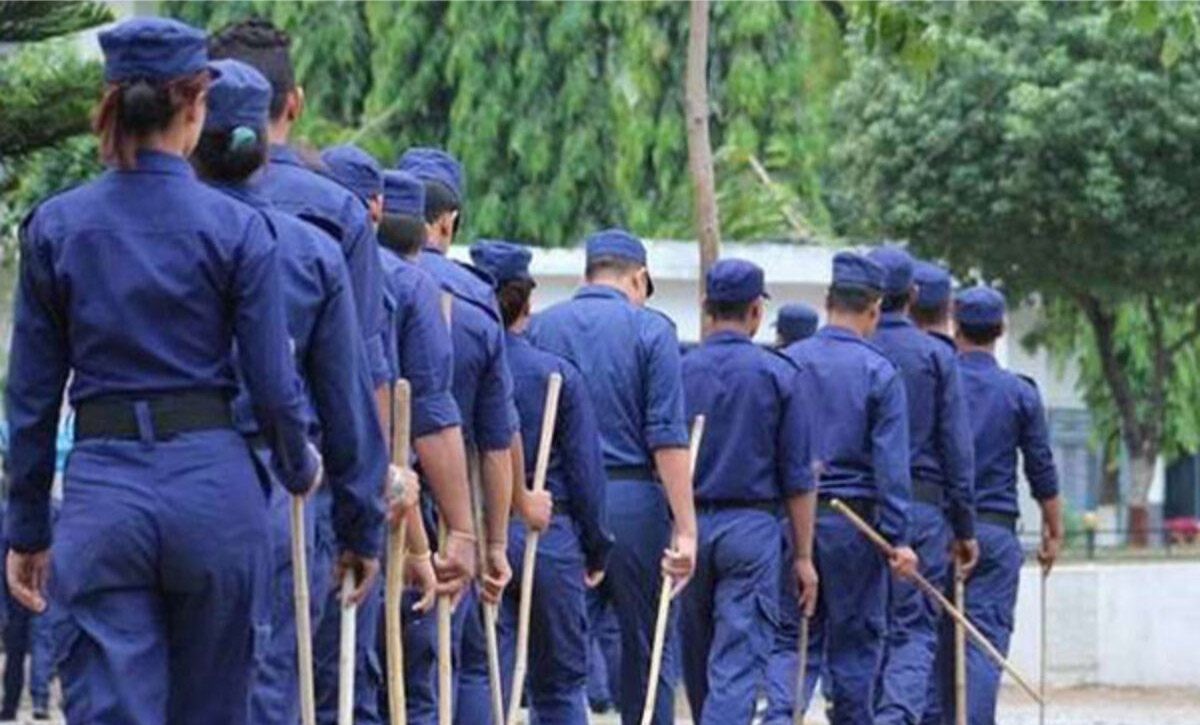
Nepal Police officials, contractors, and suppliers have been accused of colluding in a large-scale irregularity involving the procurement of uniforms for election police (temporary police), causing losses of more than Rs 400 million to the state treasury. According to senior police sources, uniforms meant for temporary police deployed for election security were purchased at abnormally inflated prices.
Taking advantage of provisions in the Public Procurement Act that allow election-related purchases without a tender process, Nepal Police is accused of awarding uniform supply contracts to a limited number of contractors through “setting.” After the government approved the recruitment of 133,980 temporary police personnel for election security for the polls scheduled on Falgun 21, Nepal Police began the recruitment process under the “Unified Procedure on Recruitment, Selection, Appointment, and Mobilization of Election Police–2082.” Training is currently underway, and the alleged irregularities surfaced during preparations to procure uniforms for field deployment.
As per the procedure, each temporary police officer must be provided with a shirt and trousers, shoes, socks, belt, sweater, and baton. Police Headquarters approved a budget of Rs 6,500 per person for these items. However, police officials themselves claim that the same set of items costs around Rs 3,500 at market rates. According to estimates, two sets of uniforms cost about Rs 2,000, fabric shoes Rs 600, a belt Rs 150, a sweater Rs 500, two pairs of socks Rs 150, and a baton Rs 100, bringing the total close to Rs 3,500. Manufacturers say the items could be supplied even cheaper.
Despite this, Police Headquarters allegedly approved Rs 6,500 per temporary police officer in coordination with select contractors. Companies that reportedly received supply contracts include Jay Salina Enterprises run by Gyanendra Basnet, Samriddhi International run by Mitra Lama, Kamongkhala run by Shravan Agrawal, and Jay Hanuman Enterprises run by Rajman Mishra, all of whom have previously supplied uniforms to Nepal Police and Armed Police Force. Sources claim Police Headquarters allocated specific districts to these suppliers.
A police officer from Madhes Province said district police offices were instructed to sign agreements only with suppliers designated by Police Headquarters and to make payments of Rs 6,500 per temporary police officer as directed from the center. While the unified procedure states that uniform expenses will be provided at rates set by Police Headquarters, it does not clearly specify whether the amount should be given directly to the temporary police or managed through district police offices. Police Headquarters, however, claims it only coordinated uniform management due to time constraints and that the funds will be provided directly to the temporary police.
Despite the scale of the allegations, the Ministry of Home Affairs and Home Minister Om Prakash Aryal have remained silent. Ministry officials say they are unaware of the issue, while the minister’s secretariat has stated that action will be taken if complaints or evidence are presented.
Nepal Police Central Spokesperson DIG Abhinarayan Kafle has denied any irregularities, stating that uniform procurement responsibility lies with all 77 district police offices and that Police Headquarters has no direct involvement. He said districts are free to procure uniforms as per their needs under provisions that do not require tenders. However, he did not clearly address questions regarding rate determination and authority as mentioned in the unified procedure, and said he would provide further clarification after looking into the matter.
About the Author