
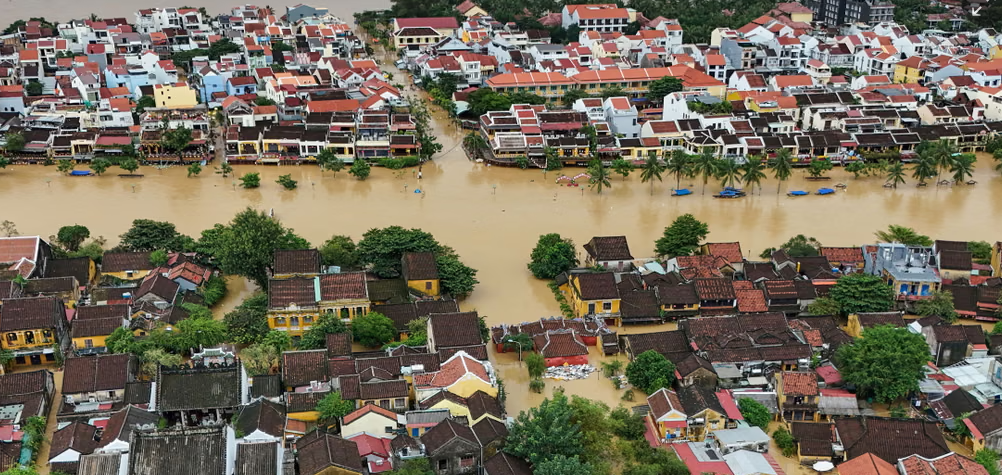
At least 35 people have died and five others remain missing due to continuous heavy rainfall and flooding in central Vietnam.
According to disaster management officials, coastal regions have been severely affected after rainfall reached up to 1.7 meters (5 feet 6 inches) within the past 24 hours. The victims were reported from Hue, Da Nang, Lam Dong, and Quang Tri provinces, according to Vietnam’s Disaster and Dike Management Authority.
The ancient city of Hoi An, a UNESCO World Heritage site, has been submerged under waist-deep water. With local rivers reaching their highest levels in 60 years, residents have resorted to using boats to move around.
“Everyone is in shock. We had prepared for flooding, but we didn’t expect the water to rise this high,” said local resident Chuong Nguyen. “Many houses couldn’t be evacuated in time, causing major losses.”
Authorities reported that more than 16,500 homes have been flooded, over 40,000 livestock and poultry swept away, and around 5,300 hectares of farmland destroyed. The Environment Ministry stated that more than 100,000 houses have been affected, and landslides have occurred in over 150 locations.
Scientists warn that human-induced climate change is intensifying extreme weather events such as floods, storms, and landslides, making them more deadly and destructive. Vietnam lies in one of the world’s most active tropical cyclone zones, typically experiencing heavy rainfall from June to September.
However, the country has already faced 12 tropical storms in 2025 alone. Government statistics show that in the first nine months of this year, 187 people have died or gone missing due to natural disasters.
The government estimates the economic damage from recent floods and natural disasters has exceeded $610 million. Relief and rescue operations are underway, but continuous rainfall is making efforts extremely challenging.
About the Author